
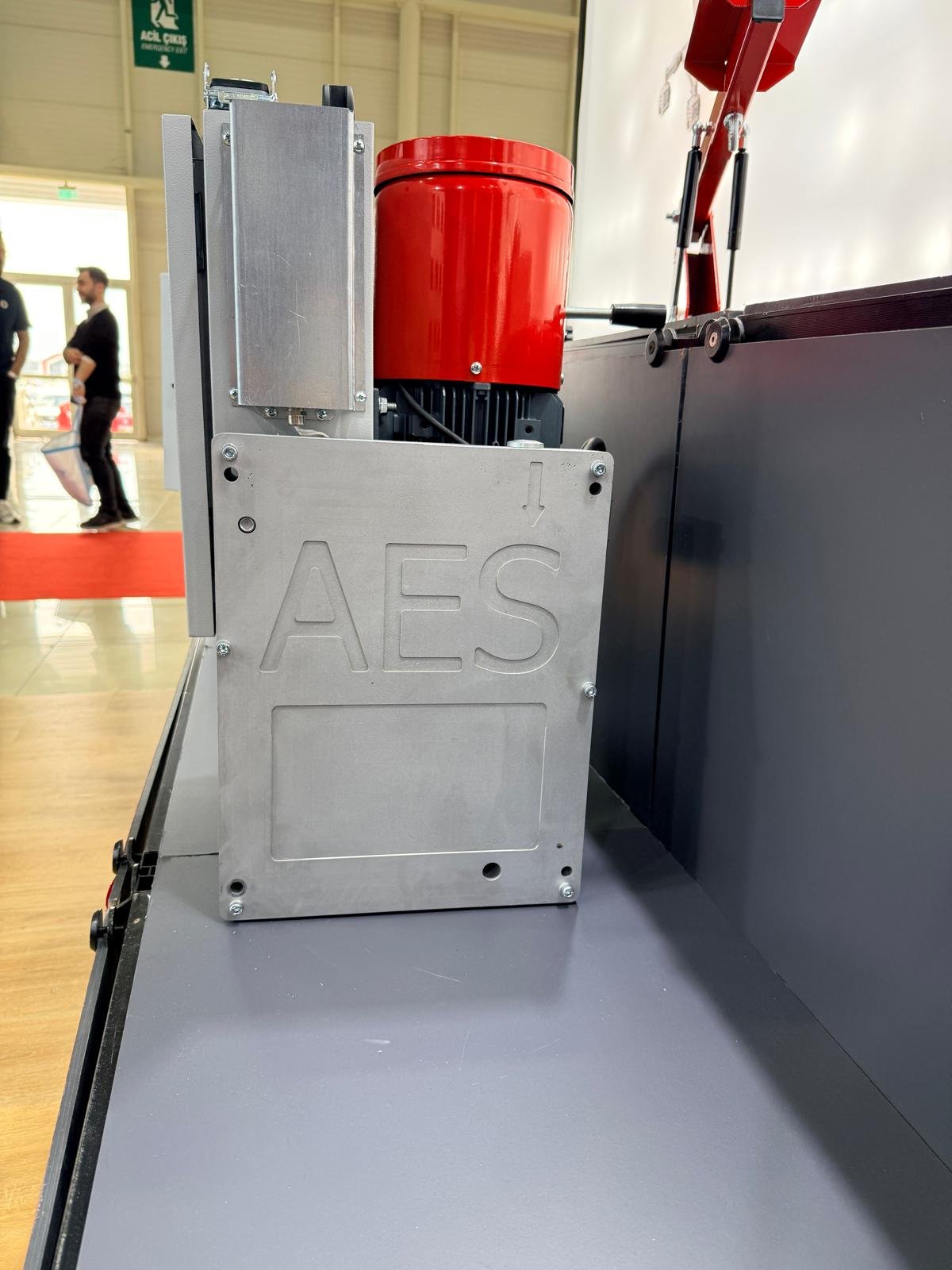
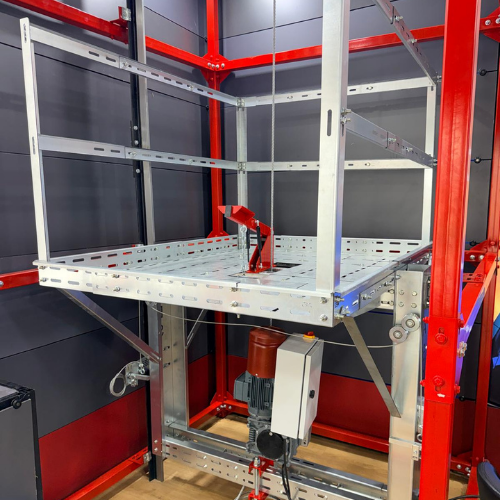
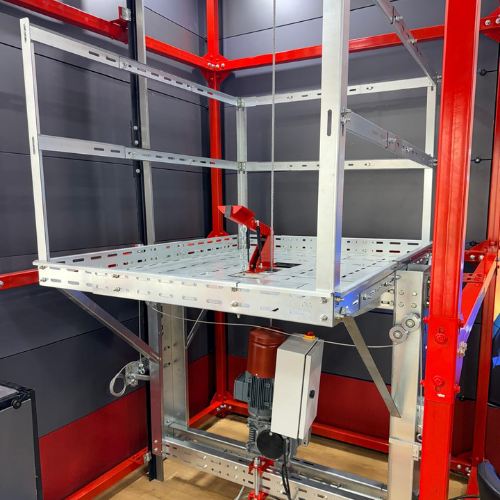
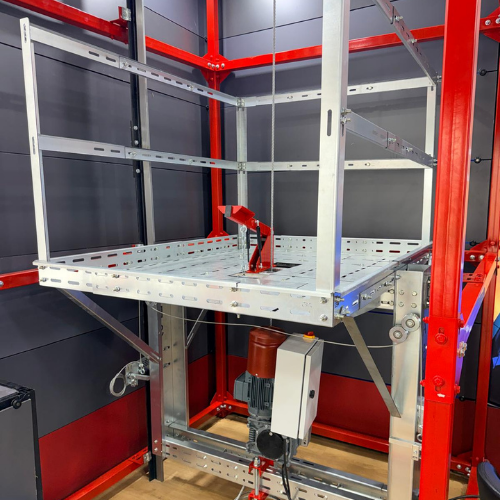
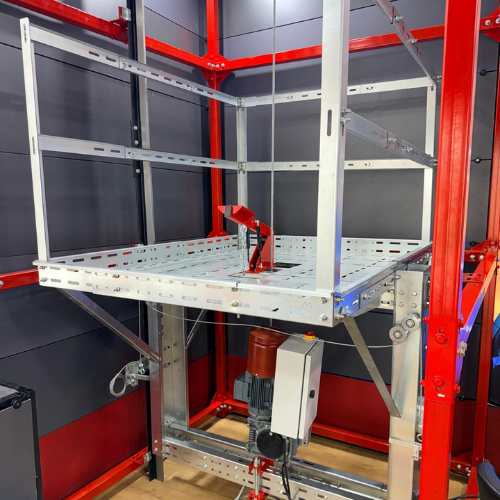
Elevator installation without drum limitations.
AES traction winches travel along the steel wire rope instead of winding it onto a drum. The working height is therefore determined mainly by rope length, while rope entry geometry and pulling speed remain more consistent throughout the travel.
What is a traction winch?
In a conventional drum winch, wire rope is stored in layers on a drum. In a traction winch, the rope passes through the drive mechanism and continues through the machine. This architecture is especially useful in elevator shafts and other vertical access applications where long travel, compact equipment and predictable rope behaviour are important.
Long vertical travel
Suitable for shaft installations where the required travel exceeds practical drum storage lengths.
Stable rope path
The wire rope enters the winch from a consistent path instead of shifting across a drum as layers build up.
Project-specific control
Contactor or VVVF control, alternative supply voltages and multi-winch control can be configured according to the application.
AES traction winch series
The table below consolidates the principal specifications of the AES elevator installation winch family. Final configuration should be confirmed for the specific project and duty.
| Model | Capacity | Speed | Control | Power / Supply | Current | Rope |
|---|---|---|---|---|---|---|
| AES 500 Mini | 500 kg | 7 m/min | Contactor | 1.1 kW / 380 V | 7 mm | |
| AES 500 Mini S | 500 kg | 7 m/min | VVVF Drive | 1.5 kW / 220 V | 7 mm | |
| AES 750 | 750 kg | 18 m/min | Contactor | 1.5 kW / 380 V | 8.3 mm | |
| AES 750i | 750 kg | 9/18 m/min | VVVF Drive | 1.5 kW / 380 V | 8.3 mm | |
| AES1000 | 1000 Kg | 18 m/min | Contactor | 2.4 kW / 380 V | 7A | 10.3 mm |
| AES1000S | 1000 Kg | 9/18 m/min | VVVF Drive | 2.4 kW / 220 V | 7A | 10.3 mm |
| AES1000i | 1000 Kg | 9/18 m/min | VVVF Drive | 2.4 kW / 380 V | 9A | 10.3 mm |
| AES 2000 | 2000 kg | 9 m/min | Contactor | 3 kW / 380 V | 10 A | 10.3 mm |
| AES 2000D | 2000 kg | 9 m/min | VVVF Drive | 3 kW / 380 V | 10 A | 10.3 mm |
Options that adapt the system to the job
Control and safety equipment is selected according to the intended duty, installation method and applicable project requirements.
Safety is a system, not a single component.
A traction winch must be evaluated together with its rope, suspension, electrical control, braking and—when applicable—independent safety equipment. Human lifting applications require additional safeguards and must be designed for the applicable requirements.
Control cabinets can include master control / emergency-stop contactors, phase monitoring and protected control circuits depending on configuration.
Selected configurations allow controlled manual lowering during a power interruption through the brake release and dedicated safety arrangement.
Independent capture devices can be integrated according to the application to respond to overspeed or platform inclination.
Do not select the model by capacity alone.
Capacity, speed, supply voltage, rope diameter, control architecture, travel, suspension arrangement and required safety equipment should be evaluated together. Shaft dimensions and site power information are key inputs for selecting the correct configuration.
Traction winch FAQ
What is the difference between a traction winch and a drum winch?
A drum winch stores the wire rope on a drum. A traction winch drives the rope through the machine, so the available travel is not defined by drum storage capacity.
Can traction winches operate at variable speed?
Yes. AES models include both contactor-controlled fixed-speed configurations and VVVF-drive configurations, depending on model and application.
Can multiple winches operate together?
Where required, multi-winch control and synchronized movement can be configured according to the project.
How is the correct model selected?
The selection should consider capacity, speed, supply voltage, rope diameter, control architecture, suspension arrangement, duty and required safety equipment together.
Not sure which configuration fits your shaft?
Send the shaft dimensions, required load, travel and site power information. AES can prepare the suitable winch and control configuration for the project.